
Cricket legend Sachin Tendulkar's visit to the Bastar region in Chhattisgarh is hailed as a source of inspiration for youth, promoting sports and instilling confidence in the once Maoist-affected area.

The Bastar region of Chhattisgarh, India, is transitioning away from decades of Maoist conflict, with plans to convert security camps into public infrastructure. A senior Maoist commander recently surrendered, marking a significant step in the government's efforts to eliminate Naxalism.

President Droupadi Murmu stated that government actions against Maoists have improved the atmosphere in Bastar, Chhattisgarh, leading to development. She encouraged those who have left violence to trust the Constitution.

After more than four decades, Chhattisgarh's Bastar region has been declared free of Left-Wing Extremism (LWE), marking the end of the armed Maoist rebellion in the area. The decline is attributed to sustained security operations, improved governance, and socio-economic development initiatives.

In a significant victory for the government's anti-Naxal efforts, 108 Maoists, including 44 women, surrendered in Chhattisgarh's Bastar district, citing disillusionment and the appeal of rehabilitation programs. The surrender also led to the recovery of a large cache of weapons and valuables.
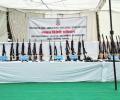
Police in Chhattisgarh's Bijapur district have recovered a cache of explosives, weapons, and equipment allegedly hidden by Maoists in a forested hill area.
108 Maoists surrendered in Chhattisgarh's Bastar district, yielding a large cache of weapons and cash. The surrender highlights the government's success in combating Left Wing Extremism and the weakening of Maoist ideology.
Police in Chhattisgarh's Bijapur district have recovered a cache of explosives, weapons, and equipment allegedly hidden by Maoists in a forested hill area.

Three District Reserve Guard personnel were killed and another injured in an IED blast in Chhattisgarh's Kanker district while attempting to neutralise it.
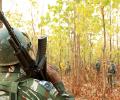
Security forces in Chhattisgarh's Kanker district have recovered a significant cache of firearms, ammunition, and explosives from Maoist hideouts during search operations.

Chhattisgarh Chief Minister Vishnu Deo Sai praised Sachin Tendulkar's visit to the Bastar region, highlighting its inspirational impact on children and youth. Tendulkar's visit to Dantewada district, as part of a grassroots sports initiative, signifies the region's transformation from a Maoist stronghold to a hub of development and opportunity.
Wreaths were laid on the mortal remains of three of the four police personnel killed in an explosion in a gunpowder dump of Maoists in Chhattisgarh's Kanker district.

Security forces killed 14 Naxalites, including wanted ultras Mangtu (DVCM) and Hunga Madkam, in separate encounters in Chhattisgarh's Sukma and Bijapur districts in the Bastar region on Saturday, officials said.
Security forces in Chhattisgarh's Bijapur district have recovered a significant amount of cash, arms, ammunition, and explosives from Maoist hideouts in the forests during search operations.
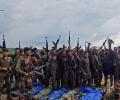
A woman Maoist carrying a reward of Rs 5 lakh was killed in an encounter with security personnel in Chhattisgarh's Kanker district.

The Maoists in Bastar went from one village to another with kits providing badly needed medical intervention. The medical help was one key reason why the tribals were attracted to the Maoists, points out M R Narayan Swamy.

Two police constables in Chhattisgarh allegedly committed suicide in separate incidents, apparently due to family-related issues. One constable shot himself with his service rifle, while the other was found hanging at his residence.
A 19-year-old man allegedly snatched the mobile phone of BJP MLA Dharamlal Kaushik during his morning walk in Raipur. The accused was arrested within eight hours, but the incident has sparked political controversy.
Chhattisgarh Chief Minister Vishnu Deo Sai announced that North Bastar and Abujhmad regions are now free of Naxal violence, with the fight against Naxalism in South Bastar reaching a decisive phase. He attributes this success to trust-building measures and the surrender of Naxal cadres.
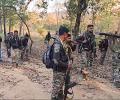
A Naxalite carrying a bounty of Rs 5 lakh was killed in an encounter with security personnel in Chhattisgarh's Sukma district, just days before the Centre's deadline to eliminate Left Wing Extremism.

Cricket legend Sachin Tendulkar participated in an event in Chhattisgarh's Dantewada district as part of a grassroots sports initiative aimed at transforming the once Maoist hotbed into a thriving sports hub and opening new avenues for the youth.
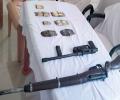
Chhattisgarh Deputy Chief Minister Vijay Sharma announces the impending surrender of senior Maoist commander Papa Rao and his team, a significant step towards eradicating Naxalism in the state.
The Enforcement Directorate (ED) is investigating the use of foreign debit cards by a global Christian mission to withdraw crores of rupees in Naxal violence-hit regions of India. Searches were conducted in multiple states, and foreign debit cards, cash, and digital devices were seized.

A Naxalite was killed in an encounter with security forces in Chhattisgarh's Sukma district, just two days before the Centre's deadline to eliminate Maoism from the country.
A senior Maoist commander, Papa Rao, surrendered with his team in Chhattisgarh, signalling a significant blow to Left-Wing Extremism in the region. This event underscores the impact of sustained security pressure and rehabilitation efforts on the Maoist movement.
The Lok Sabha will hold a discussion on efforts to eliminate left-wing extremism (LWE) in India, ahead of the government's deadline. The debate will cover the government's strategy, review of affected regions, and future plans, including potential withdrawal of security forces and launch of welfare schemes.

Two Naxalites, carrying a collective reward of Rs 7 lakh, were killed in an encounter with security forces in Bijapur district of Chhattisgarh. The operation was launched based on inputs about the presence of Maoist cadres in the area.

As the March 31 deadline arrives, a wave of Maoist surrenders suggests insurgency's end, but political and social concerns remain.

A combination of security pressure and rehabilitation efforts has significantly weakened Naxalism in India, leading to numerous surrenders and the elimination of key leaders.

The Tricolour will be hoisted for the first time on Republic Day in 41 villages freed from Maoist influence in Chhattisgarh's Bastar region, marking a success in the fight against 'Red Terror' and heralding peace and development.

A security camp has been established in the Naxalite-hit Sukma district of Chhattisgarh to improve security and facilitate development. The camp, set up by security forces, aims to dominate the area, secure development works, improve coordination with villagers, and intensify anti-Naxal operations.

'The Maoist leadership spread fear that surrender meant torture or death. Once that false narrative collapsed and our operations proved transparent and credible, the surrender momentum became irreversible.' 'From 42,000 square kilometres, Maoist activity is now confined to barely 500-600 square kilometres -- less than two per cent of Bastar. This is their last remaining base area.'
Three Naxalites, including a woman, carrying a reward of Rs 12 lakh, were killed in an encounter with security personnel in Chhattisgarh's Sukma district. The encounter took place in Gondiguda, and a large cache of arms and explosives were recovered.
Fifteen Naxalites, including a veteran ultra with a significant bounty, surrendered in Chhattisgarh, effectively dismantling the Maoist movement in the Raipur-Sambalpur region.

Inspector general of police, Bastar Range, Sundarraj P said that bodies of seven Maoist cadres have been recovered from the encounter site so far.

210 Maoist cadres, including a Central Committee member, surrendered to authorities in Chhattisgarh's Jagdalpur, marking the "largest mass surrender" in the state's anti-Naxal operations. The surrendered Naxalites carried a collective bounty of Rs 9.18 crore and handed over 153 weapons. Chief Minister Vishnu Deo Sai hailed the development as a historic moment for Chhattisgarh and the nation.

'From every point of view, they have faced an extremely difficult couple of years, and the setback they have suffered is irreversible.' 'This reality has begun to set in even amongst the top-level cadres. That is why, in recent times, we have witnessed a huge number of senior-level cadres emerging from the jungle and deciding to renounce violence and join the mainstream.'
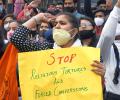
The Chhattisgarh high court has disposed of two petitions seeking the removal of hoardings prohibiting entry to pastors and 'converted Christians' in eight villages, holding that they were installed to prevent forced conversions through allurement or fraudulent means and cannot be termed as unconstitutional.
After recent high-intensity operations in the Bastar region and the neutralisation of several senior Maoist leaders, officials say the insurgency has lost its ability to mount large-scale coordinated attacks.

During his visit to the Bastar district headquarters in the poll-bound state, the prime minister is scheduled to address a Bharatiya Janata Party rally.
 © 2026 Rediff.com - Advertise with us - Disclaimer - Privacy Policy - Sitemap - Feedback - About us - Terms of use - Grievances